9
min read
Cognitive load and end-of-shift documentation quality for nurses
How mental fatigue accumulates during nursing shifts and why end-of-shift documentation quality suffers. Evidence-based solutions for hospitals
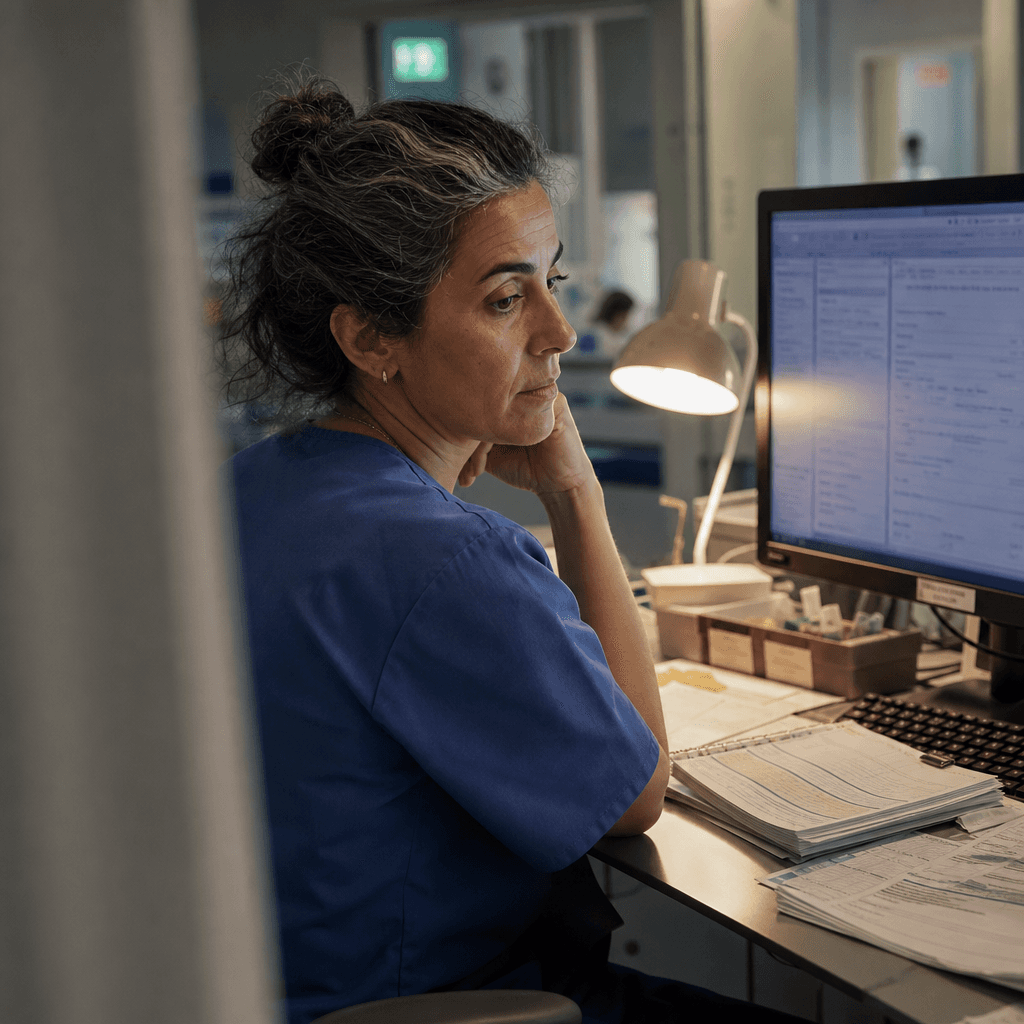
End-of-shift documentation quality falls because cognitive resources are finite. By the time a twelve-hour shift ends, the same mental capacity needed for accurate clinical records has already been heavily drawn on by every assessment, decision, and interruption that came before it.
What cognitive load actually means for nurses on a shift
Cognitive load is the total mental effort a person is using at any given moment. In clinical settings, three types are particularly relevant. Intrinsic load is the inherent complexity of the task itself: assessing a deteriorating patient, interpreting abnormal observations, or managing a complex medication regimen. Extraneous load comes from the environment, interruptions, noisy wards, malfunctioning equipment, and poorly designed medical record system interfaces. Germane load is the effort devoted to forming clinical judgements, integrating new information, and building a mental picture of each patient.
All three draw on the same finite pool of mental resources. When that pool is depleted through sustained high demand, interruptions, and time pressure, vigilance falls, decision-making quality drops, and task performance degrades. This is confirmed by a scoping review of cognitive mental workload in emergency nursing published in Nursing Open, and reinforced by a scoping review in the International Journal of Nursing Studies which found that contextual cognitive demands significantly affect clinical judgement in real-world practice in ways that vignette-based research consistently misses. Documentation competes directly with every other cognitive task a nurse performs, drawing on the same depleted pool.
How cognitive demand builds across a shift and peaks at the worst possible moment
A 12-hour hospital shift doesn't distribute cognitive demand evenly. Handover is intensive from the first minute: nurses have to hold dense, compressed information about multiple patients in working memory while cross-referencing it against prior knowledge. Early medication rounds then add procedural complexity on top of that informational load. Mid-shift typically brings the highest unpredictability, with deteriorating patients, emergency admissions, and rapid switching between different clinical contexts.
By the final hours, fatigue compounds everything that came before. A prospective study of 90 nurses using wearable devices to track alertness found a 31-point reduction from the start to the end of a night shift, with fatigue emerging as the stronger predictor of medication errors and near-misses. A qualitative study of intensive care unit nurses applying Cognitive Load Theory and the Job Demands-Resources Model found that nurses move dynamically between cognitive reserve deficit, load balance, and outright cognitive overload across a shift, with high alarm frequency, multitasking, and night shifts as key risk factors. End-of-shift documentation falls at precisely the point when this accumulated depletion is greatest, which is why record quality suffers so predictably.
What interruptions do to recall, and what gets lost as a result
Interruptions don't simply slow nurses down. Each one forces the abandonment of a line of thought. When the nurse returns to that task, they have to reconstruct what they were doing, and reconstruction is imperfect. Details get compressed, sequencing errors occur, and low-salience observations are dropped first. These are subtle findings that didn't trigger an immediate action, even if they're clinically meaningful in retrospect. An integrative review of cognitive load among nurses in simulation-based learning identifies dual-tasking, interruptions, time pressure, and task complexity as the primary drivers of elevated cognitive load, the same factors that are standard features of a live hospital shift.
The documentation gaps that result follow a consistent pattern. Subtle changes in patient behaviour or affect are among the first to be omitted, particularly when they didn't prompt an immediate action. The reasoning behind clinical decisions is rarely recorded when time is short, leaving only the decision itself. Precise observation timestamps are frequently lost: "this afternoon" isn't the same as "14:20", and the difference can matter when tracking a deterioration trajectory. Verbal exchanges with patients or families about consent, preferences, or concerns are easily deferred and then forgotten. Early signs of deterioration that didn't yet meet escalation criteria are clinically significant precisely because they're subtle, and they're the most likely to be left out.
These omissions matter beyond the individual record. Incomplete notes compromise handover safety, create gaps in medico-legal records, and reduce the quality of information available to the next clinician making decisions based on what was actually documented.
Why documentation burden and nurse burnout are the same problem
Documentation burden and burnout share the same root cause. Nurses spend approximately 40 per cent of their shift on documentation, according to data cited by the American Association of Critical-Care Nurses. When that documentation is deferred to the end of the shift, nurses face a choice with no good outcome: stay late to finish records, or leave with gaps. Staying late extends an already exhausting shift and eats into recovery time. Leaving with gaps creates professional risk and the persistent mental burden of unfinished work.
European research on shift patterns and nurse burnout, including data from the Magnet4Europe programme across 56 hospitals in Belgium, England, Germany, Ireland, Norway, and Sweden, shows that administrative load frequently extends the working day beyond the paid shift. A Swiss multicentre study included in that review found patient-to-nurse ratios of 11.7 at night compared to 6.3 during the day, meaning the recording pressure is greatest precisely when cognitive resources are most depleted. A scoping review on night shift and occupational fatigue found that chronic fatigue leads to poor concentration, low mood, and reduced motivation, all of which make cognitively demanding tasks like clinical documentation harder to complete. The sense of never being fully done is a recognised driver of emotional exhaustion in nursing.
What hospitals are doing, and where ambient voice technology fits in
European healthcare systems are approaching the documentation timing problem in different ways. Point-of-care documentation, recording information immediately after an observation or intervention rather than deferring it, is increasingly recognised as a structural improvement rather than simply a matter of personal habit. Structured templates reduce the mental effort of composing a note: when a nurse doesn't need to decide what to write or how to organise it, the task becomes faster and less demanding. Standardising communication platforms has been shown to reduce cognitive load and improve documentation quality by cutting the effort required to retrieve, retain, and record information. Mobile documentation tools allow brief, real-time capture at the bedside without requiring a trip back to a fixed workstation.
Of these, redesigning workflows to protect time within the shift for documentation, rather than treating it as something to finish after care, is probably the most effective single intervention. It is also the most dependent on adequate staffing ratios, and where patient-to-nurse ratios are high, protected documentation time is hard to sustain regardless of intent. Many studies evaluating specific interventions are small-scale, single-site, or conducted in well-resourced settings that may not reflect the realities of under-resourced wards, so the evidence base remains uneven.
Ambient Voice Technology (AVT) and AI medical assistants represent a different kind of response, one that addresses the structural mismatch between when clinical events happen and when they get recorded. Rather than requiring a nurse to recall and compose a note after the fact, these tools capture clinical information at the moment it occurs. Real-time transcription converts spoken clinical observation into structured text during or immediately after an interaction, and an AI assistant can generate structured notes from that captured information. A nurse who documents verbally at the bedside immediately after an observation produces a more accurate, more temporally precise record than one who reconstructs the same observation two hours later. Documentation is also spread across the shift rather than piling up at the end, which reduces peak load at exactly the moment when cognitive capacity is lowest.
For European hospital settings, data security and compliance with the General Data Protection Regulation (GDPR) are practical considerations when procuring these tools. Any ambient voice tool deployed in a clinical environment must meet GDPR requirements around lawful processing and international transfer safeguards. Data residency matters where a vendor's infrastructure sits outside the European Economic Area (EEA). Where AI-generated clinical content could influence care decisions, tools must also comply with applicable Medical Device Regulation (MDR) frameworks. Hospitals evaluating these tools should confirm ISO 27001 certification and clear data residency commitments from any vendor.
What nurses and ward teams can do now
End-of-shift documentation quality is a systems problem with systems solutions. Individual nurses cannot resolve it through greater effort or diligence; the mechanisms involved are neurological, not motivational. There are, however, concrete steps nurses and ward teams can take within what's currently in their control.
Documenting at the point of care, even a timestamp or a single observation recorded immediately, is more accurate than a reconstructed note written hours later. If your medical record system defaults to free text, advocate for structured templates that reduce the mental effort of composing a note. Interruptions are worth naming explicitly as a documentation risk rather than a general nuisance; framing them that way gives ward leaders something concrete to address. End-of-shift recording pressure is a patient safety issue, not an administrative inconvenience, and escalating it through clinical governance channels is appropriate. Where your trust or health system is assessing ambient voice or AI documentation tools, nursing input into the procurement process, particularly around workflow fit and data security, is clinically relevant, not peripheral.
Frequently asked questions
▶ Why does cognitive load affect the quality of nursing documentation?
All three types of cognitive load draw on the same finite mental pool. Documentation sits at the back of the queue, so it absorbs whatever capacity remains after clinical tasks have already made their demands. The less capacity left, the more compressed and incomplete the resulting record.
▶ How does cognitive demand build across a 12-hour hospital shift?
Each phase of a shift adds a different kind of load: informational at handover, procedural during medication rounds, unpredictable mid-shift. These layers stack rather than reset. By the final hours, a nurse is drawing on reserves already depleted by everything that came before, which is precisely when documentation is expected.
▶ What types of clinical information are most likely to be missing from end-of-shift notes?
The pattern is consistent: subtle behavioural changes, clinical reasoning, precise timestamps, patient and family conversations, and early deterioration signs that didn't yet meet escalation criteria. What these share is low immediate salience. They didn't demand action at the time, so they're the first to be dropped when recall is compressed.
▶ How do interruptions damage nursing documentation quality?
The damage is cumulative across a shift. Each interruption discards a cognitive thread, and each reconstruction is slightly less complete than what it replaced. By the time a nurse sits down to document, the record they produce reflects a series of degraded reconstructions rather than the original observations.
▶ What is the connection between documentation burden and nurse burnout?
The link is structural. Nurses spend roughly 40 per cent of a shift on documentation, and when that work is deferred, it doesn't disappear. It either extends the shift or leaves gaps that carry professional risk. Either outcome sustains the sense of unfinished work that research identifies as a driver of emotional exhaustion.
▶ How does ambient voice technology address the timing problem in nursing documentation?
The core gain is temporal. A verbal observation captured at the bedside immediately after an event carries a precise timestamp and full detail. The same observation reconstructed two hours later carries neither. Spreading documentation across the shift also means peak cognitive depletion at the end of a shift no longer coincides with peak documentation demand.
▶ What data security and compliance requirements apply to ambient voice tools in European hospitals?
GDPR governs lawful processing and requires appropriate safeguards for any transfers outside the EEA. Where AI-generated content could influence care decisions, Medical Device Regulation frameworks also apply. Hospitals should confirm ISO 27001 certification and clear data residency commitments from any vendor before procurement.
▶ What practical steps can nurses and ward teams take to improve documentation quality?
Point-of-care capture, even a single timestamp, outperforms end-of-shift reconstruction. Structured templates reduce the effort of composition. Naming interruptions as a documentation risk gives ward leaders a concrete target. Escalating end-of-shift recording pressure through clinical governance frames it as a patient safety issue, which is what it is.
▶ What does better documentation timing look like in practice on a hospital ward?
Wards where documentation is distributed across a shift tend to share a few features: higher nurse-to-patient ratios, fast and accessible medical record system interfaces, brief structured templates completable at the bedside, and a ward culture that treats documentation as part of care delivery rather than something done after it. Staffing ratios are the hardest of these to change and the most consequential.